The Deposit That Was Drilled for the Wrong Commodity: Piedmont Magnesite, Bingara NSW
Some deposits are under-explored because nobody found them. Piedmont is the rarer case: a deposit everyone found, and nobody ever assayed.
Roughly 28–30 km SSW of Bingara, near the Gwydir River on the Cobbadah 9037-IV-S sheet, the Piedmont Magnesite Mine sits in the schistose serpentinite of the Great Serpentinite Belt, hard against the Peel Fault system. The Geological Survey of NSW called it "the only documented metahydrothermally-derived magnesite deposit in the sheet area… the third largest magnesite deposit in the belt" (Brown & Brownlow, 1990, bound as Appendix 2 to CRAE Report 16998). Historical assays run to 99.17% magnesite — microcrystalline, 1–3 µm, the texture and purity that refractory and chemical buyers specify — with typical deposit material around 95%. Seven percussion holes were drilled through it. The magnesite itself was never assayed in any of that work.
This is exactly the kind of asset open-file forensics is built for, and it makes the case study compelling: over a century of records — Department of Mines annual reports, 1960s appraisals, private drilling, a CRAE gold program, and a GSNSW excursion-guide study — each collected under a different commodity lens, none of them the right one for what the deposit actually is.
Which is why the current tenure position is so well-placed. The Group 2 (non-metallic minerals) rights over Piedmont sit within EL9377, granted to Carbozorb Pty Ltd in March 2022 — 166 units centred on the Great Serpentinite Belt, held as part of a deliberate, belt-scale strategy targeting magnesium-rich ultramafic rocks for CO₂ mineralisation. That is the first time in the deposit's history that the tenure holder's exploration model actually matches the deposit's geology. A hydrothermal magnesite lode is, in the most literal sense, a natural carbon-mineralisation cell: magnesium liberated from serpentinite, combined with CO₂-bearing fluids, locked into carbonate. Piedmont isn't a distraction from Carbozorb's stated strategy — it is the field-scale proof of the process their four-permit portfolio is designed to engineer. The open-file record validates ground they already hold.
Exploration History
1890s–1930s — Small-scale magnesite mining (various local operators). Deposit model: outcropping high-purity vein magnesite. Objective: hand-won magnesite for early industrial markets. Work: a series of pits and workings along the vein system; the NSW Department of Mines Annual Report for 1937 (p. 66) records assays up to 99.17% magnesite from material not cut by later veins. Departure: the economics of small hand-mined parcels in a remote district, decades before modern magnesia demand existed — a market constraint of the era, not a geological verdict.
1960s — Departmental and industry appraisal (Wynn 1960; Ringis 1965). Deposit model: magnesite-dolomite vein system. Objective: characterise the deposit and its dolomite potential. Work: geological description of the lenticular, steeply-dipping veins within the quartz-magnesite alteration envelope; the dolomite was assessed as insignificant. Departure: appraisal-era work programs ended with the reporting cycle — there was no exploration-licence framework driving follow-up drilling at the time.
Pre-1990 — Melcann Pty Ltd (David Mitchell) — the only drilling ever done. Deposit model: vein/pod magnesite. Objective: "to test the extent of the Piedmont Magnesite deposit" (CRAE 16998). Work: seven percussion holes (PP1–PP7) over ~500 m of strike, to ~30 m depth. Departure: a private company's program that, as far as the open-file record shows, never lodged magnesite assays — a common fate of private-operator data in the pre-digital reporting era.
1988–1992 — CRA Exploration Pty Ltd, EL3117 "Mt Everest". Deposit model: Mother Lode-style serpentinite-hosted gold and Cyprus-Besshi VMS base metals on the Peel Fault. Objective: gold — Piedmont was tested on the elegant theory that the magnesite-forming hydrothermal system might also have concentrated gold, by analogy with their Lost Chance prospect. Work: obtained Melcann's cuttings, composited to 4 m, assayed for Au (AAL Drake, Sept 1990) — every sample <0.01 ppm; plans NSWs4634/4635 lodged. Departure: with the gold hypothesis cleanly disproven and results elsewhere on the licence disappointing, CRAE recommended full relinquishment in 1992 (CRAE 18122). An entirely rational exit for a major-company gold explorer in a soft gold market — magnesite was simply never their commodity, and Group 2 minerals weren't on their licence.
1990 — Geological Survey of NSW (Brown & Brownlow; Brownlow & Ashley in prep). Objective: scientific documentation, not exploration. Work: the Manilla–Narrabri excursion guide classified the district's three magnesite styles and identified Piedmont as the belt's only type-2 (massive hydrothermal vein) deposit. This remains the best technical description of the deposit — and it carried no drilling budget.
2022–present — Carbozorb Pty Ltd, EL9377. The latest and most informed chapter. Carbozorb's Group 2 licence — one of four permits covering 2,161 km² of ultramafic-prospective ground in NSW — was taken up on a carbon-mineralisation thesis: magnesium-rich ultramafics as reactive rock for in-situ or ex-situ CO₂ sequestration, with point-source and solar-powered DAC options under assessment. It is the first tenure in the deposit's history held under the mineral group Piedmont actually belongs to, by a team whose exploration model is the very process that formed the deposit.
Why the Grade Is Still Open
Every operator measured something other than the magnesite. The miners measured what they could hand-sort; the 1960s appraisals described but did not systematically sample; Melcann drilled but lodged no assays; CRAE assayed the drill cuttings — for gold only. Cross-referencing all eras, there is not a single modern MgO, CaO, SiO₂, Fe₂O₃ or LOI determination on file for the belt's third-largest magnesite deposit.
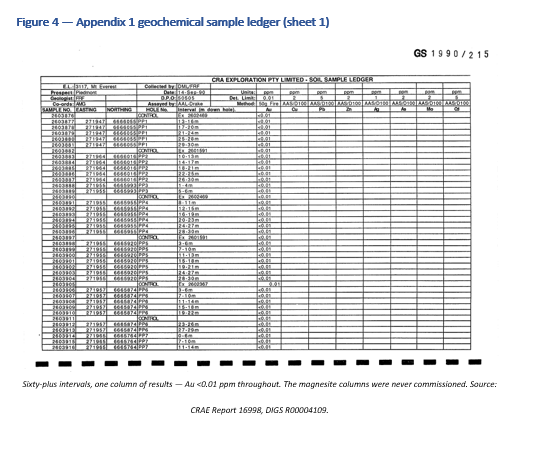
The drilling exists — the data gap is analytical, not physical. PP1–PP7 define ~500 m of drilled strike with cuttings intervals fully ledgered (CRAE 16998, Appendix 1; sections on NSWs4634, workings plan on NSWs4635). CRAE's gold ledgers even preserve the exact downhole intervals. The skeleton of a maiden resource programme is already on open file.
Depth and strike are untested beyond 30 m. All seven holes stop at ≤30 m on a vein system that is steep-dipping, lenticular, and coalesces into an 8 m pod in one pit. No hole tested below the base of the historic workings' third dimension, and the alteration envelope — the exploration vector — was never mapped beyond the mine area.
The CRAE gold nulls are quietly valuable. Uniform <0.01 ppm Au across 60+ composites tells a 2026 reader two things the 1990 reader didn't need: the deposit is geochemically clean (a feedstock virtue for both refractory and carbon-mineralisation applications), and the hydrothermal system was a pure Mg-carbonate cell — precisely the natural analogue a CO₂-mineralisation program wants to characterise.
The miss, precisely. Seven drillholes were put through the third-largest magnesite deposit in the Great Serpentinite Belt, and the magnesite was never assayed — the only laboratory data ever generated from that drilling was a gold program, run by an operator whose licence didn't cover industrial minerals, in an era when magnesia markets and carbon mineralisation didn't yet exist as exploration drivers. Every historical operator left for reasons that made sense in their decade. The result is a documented 95–99% purity deposit, with 500 m of drilled strike on open file, whose grade, chemistry and carbonation behaviour remain entirely open — under tenure, for the first time, whose holder's strategy is built for exactly this rock.
Significant Results Table
For an industrial-mineral system the "grade" is purity and geometry, so the table reports both — plus the only lodged assays, which are the gold nulls.
Result | Source | Operator / Era | Why it matters |
Up to 99.17% magnesite (material not cut by later veins) | NSW Dept of Mines Annual Report 1937, p. 66 (cited in GSNSW notes, CRAE 16998 App. 2) | Mining era | Places Piedmont in the high-purity bracket refractory and chemical buyers specify — before any beneficiation. |
Typical ~95% magnesite, microcrystalline (1–3 µm) | Brown & Brownlow 1990 excursion guide (CRAE 16998 App. 2) | GSNSW | Deposit-wide quality, not a hand-picked specimen; the fine crystal size is the texture calciners favour. |
Veins to 2 m wide, coalescing to an 8 m pod in one pit | Wynn 1960; GSNSW notes (CRAE 16998 App. 2) | Departmental era | Demonstrates the veins thicken and merge — the geometry upside a 30 m-deep drill pattern cannot close off. |
PP1–PP7: ~500 m of drilled strike, sampled 0–30 m (e.g. PP1 13–30 m, PP4 8–30 m, PP7 0–20 m) | Melcann drilling; ledgers in CRAE 16998 App. 1; plans NSWs4634/4635 | Melcann (pre-1990) | The deposit's entire drill database — physically real, spatially located, analytically empty. |
All composites <0.01 ppm Au (4 m composites, AAL Drake) | CRAE 16998 (DIGS R00004109); confirmed in CRAE 18122 (R00000691) | CRAE, Sept 1990 | The only assays ever lodged: they sterilise the gold theory and certify a geochemically clean Mg-carbonate system. |
"Third largest magnesite deposit in the belt; only documented metahydrothermal type" | GSNSW notes (CRAE 16998 App. 2) | GSNSW | Independent, survey-authored ranking — the belt-scale significance statement a private data room can't buy. |
Geological Setting
Piedmont lies in the Weraerai terrane — the Great Serpentinite Belt (Woodsreef Mélange) — a north-trending corridor of dismembered ophiolite (serpentinite, gabbro, dolerite, harzburgite) emplaced along the Peel Fault, bounded west by the Gamilaroi-terrane Noumea Beds and east by the Djungati-terrane Woolomin Group. The deposit is GSNSW type-2: discrete, massive, steeply-dipping lenticular veins of high-purity microcrystalline magnesite, up to 2 m wide and locally coalescing to 8 m, developed within an envelope of pervasive quartz-magnesite (silica-carbonate) alteration of schistose serpentinite. Colloform-banded quartz–?ferroan-magnesite veins and late quartz-?dolomite veinlets crosscut the ore; the dolomite resource is insignificant. Sharp vein margins and the alteration halo argue a hydrothermal origin, while the microcrystalline texture hints at kinship with the district's nodular magnesites — a genetic question GSNSW explicitly left open, and one with direct relevance to how magnesium moves and precipitates in this belt.
Top 3 Targets
Target 1 — The Piedmont lode below 30 m and along strike. Twin or deepen the PP-series pattern with a short RC program, assaying for the full industrial-mineral suite (MgO, SiO₂, CaO, Fe₂O₃, LOI, trace) plus carbonation-relevant mineralogy. What it achieves: converts a 90-year-old purity legend into modern data, and closes off — or opens — the geometry the 8 m pod implies. Alignment: gives Carbozorb a quantified natural-carbonate endmember on its own ground, plus optionality on high-purity MgO feedstock, a commodity attracting attention precisely as carbon-mineralisation feedstock and as a supply-diversification play against Chinese-dominated magnesia supply.
Target 2 — The quartz-magnesite alteration envelope as a mapped palaeo-CO₂ plumbing system. Map and sample the silica-carbonate halo outward from the workings to establish the geometry, structural controls and fluid pathways of a natural CO₂-mineralisation cell. What it achieves: Piedmont becomes a characterisation site — permeability architecture, reaction fronts, sealing behaviour — that directly informs site selection for in-situ mineralisation, which Carbozorb's public materials identify as one of its two deployment modes. This is the target no previous operator could even have conceived of; it required the 2020s to exist.
Target 3 — Belt-scale repeats within EL9377. Piedmont is the only documented type-2 deposit — a statement about documentation, not endowment. Systematic prospecting of the schistose serpentinite corridor (mapping, geochemistry over structural intersections analogous to Piedmont's setting), plus reconnaissance of type-3 nodular superficial magnesite as low-cost reactive feedstock. What it achieves: tests whether the belt's third-largest deposit has undocumented siblings across a 166-unit licence. Alignment: this is Carbozorb's stated belt-scale ultramafic strategy, executed with a vector — the Piedmont alteration signature — that history has already calibrated for them.
Closing statements
This article is not a JORC (2012)-compliant statement. Historical results are reported from open-file sources and have not been verified by a Competent Person.
All data are sourced from publicly available NSW DIGS open-file records, NSW MinView tenure data and public company disclosures. CAADIA Metals has no interest in, and no commercial relationship with, Carbozorb Pty Ltd; the Group 2 mineral rights over the subject area are wholly held by Carbozorb Pty Ltd under EL9377.
This article is general information only and is not investment advice or a recommendation regarding any company or its securities.
The full technical synthesis, intercept overview, drill plan and source register are available on request.